
PoxScan.io
50M tokens migrated from Tron to a new Layer 1 with zero losses
PolluxChain was migrating from a Tron TRC-20 token to an independent Layer 1 and needed a production-grade explorer to prove its performance, support a zero-loss token swap, and earn market credibility.
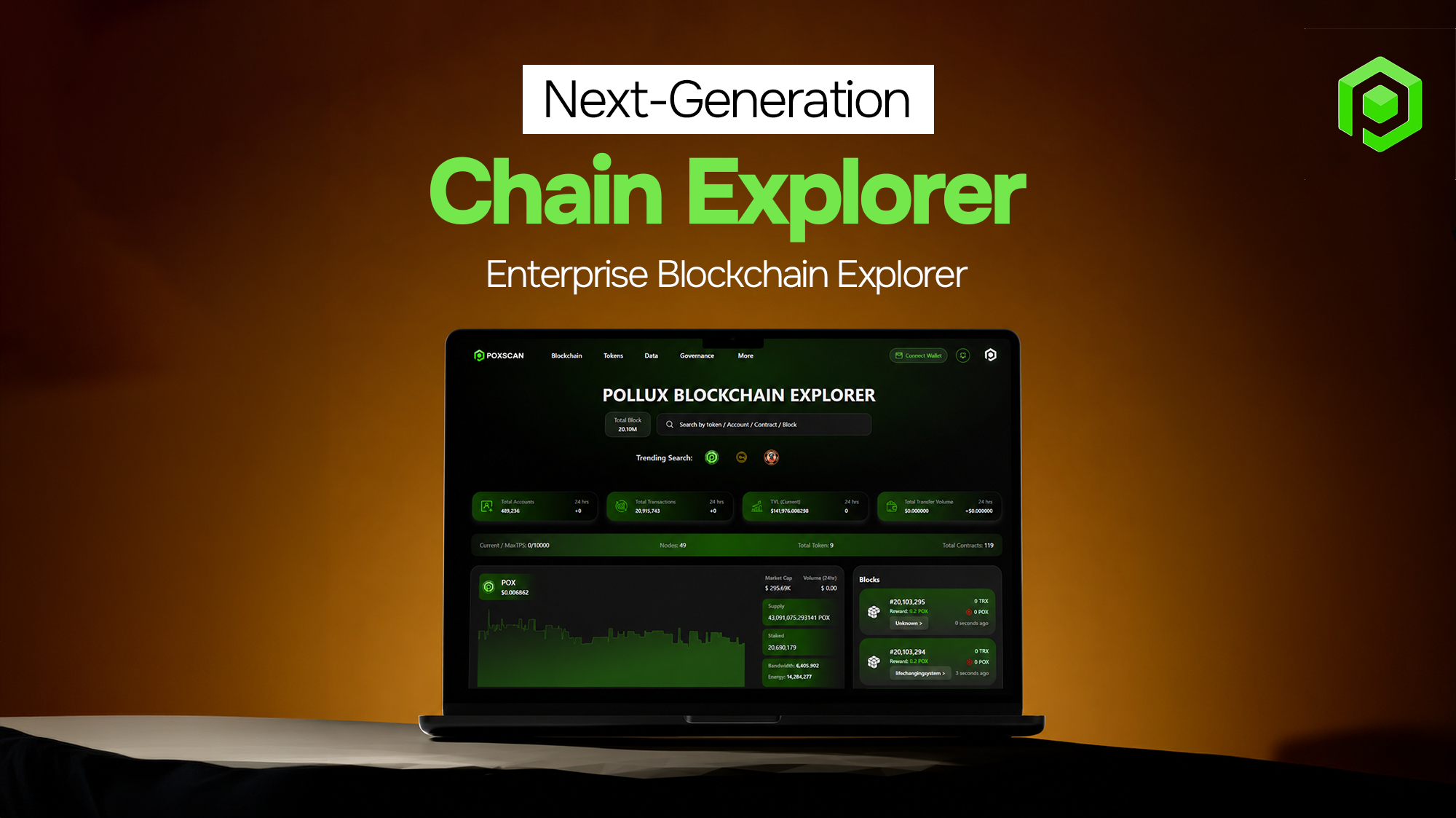
PoxScan.io is the explorer at the centre of the PolluxChain ecosystem, built by LBM Solutions in Mohali, Punjab. PolluxChain began in 2021 as a Tron TRC-20 token and evolved into a Layer 1 blockchain using Delegated Proof-of-Stake, with a 50 million POX total supply, roughly 33 million circulating, and 27 elected Super Representatives. Every serious blockchain needs a reliable explorer; without one, PolluxChain would look incomplete or untrustworthy to developers, investors, and users.
When PolluxChain approached LBM Solutions in mid-2023, they faced one of the hardest transitions in blockchain: migrating from a Tron TRC-20 token to an independent Layer 1. That required not just technical excellence but immediate credibility in a crowded market.
Four challenges defined the work. Mainnet migration support, to execute a flawless token swap from TRC-20 to native POX with full transparency through the February 2024 window. Network credibility, demonstrating claimed performance of 2,000-plus TPS publicly through professional-grade infrastructure. Developer attraction, through a complete API ecosystem with documentation, SDKs, and tools. And user accessibility, with interfaces serving everyone from casual users checking balances to validators monitoring network health.
We designed a performance-optimized, scalable architecture built to grow with PolluxChain. A user interface layer in React 18.2 and Next.js 13 with TypeScript, Tailwind CSS, Shadcn/ui, and Framer Motion. An Nginx API gateway with SSL termination, request routing, and rate limiting across multiple server instances. An application layer on Node.js 18 with Express.js, a continuous blockchain indexer, an analytics engine, and Elasticsearch-powered search. And a multi-database data layer using MongoDB for primary storage, Redis for caching, Elasticsearch for full-text search, and PostgreSQL for complex analytics.
Infrastructure ran on AWS with Docker and Kubernetes, GitHub Actions CI/CD, and Prometheus and Grafana monitoring. Multi-layer caching across browser, CloudFront CDN, Redis, and MongoDB delivered 1.8-second load times, 40% faster than target and quicker than Etherscan's 2.1 seconds, while Socket.io WebSockets delivered real-time updates at just 85 milliseconds of latency.
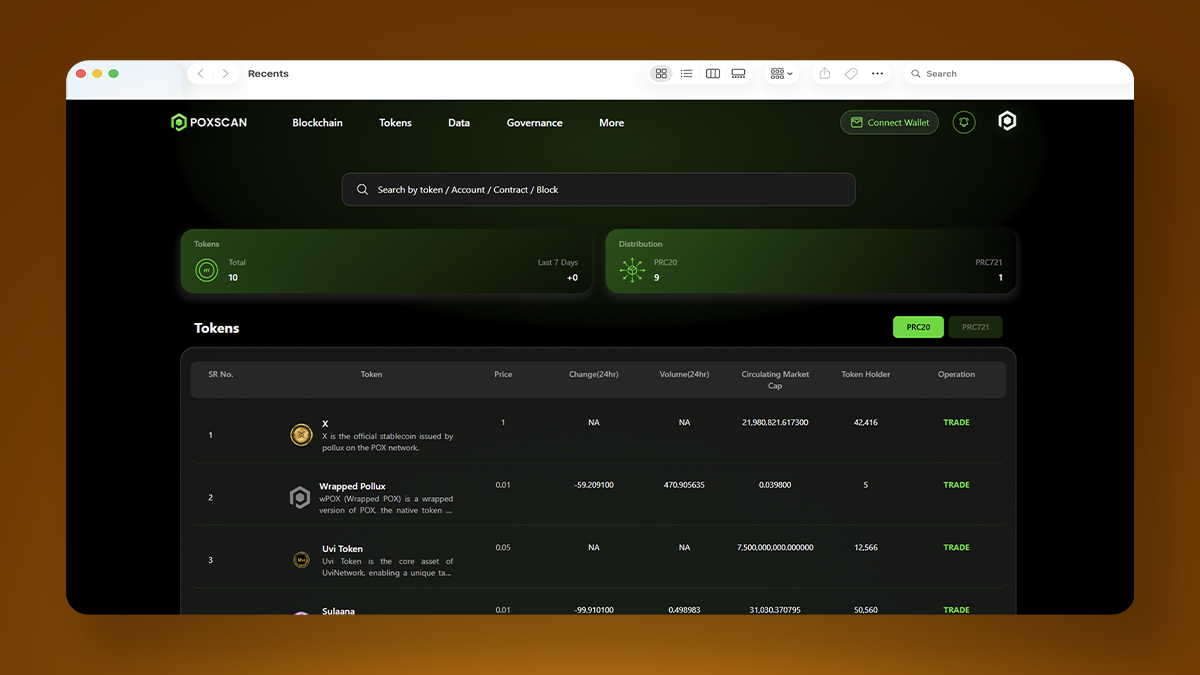
The explorer delivered comprehensive exploration for every stakeholder: a real-time block explorer with a live block feed; transaction tracking via universal search across hashes, blocks, and addresses; address analytics showing POX balance, bandwidth and energy resources, history, token holdings, staking, and voting activity; smart-contract verification that compiles submitted source, compares bytecode with the on-chain deployment, and exposes read and write interfaces; a token registry with price data and holder distribution; and a network-statistics dashboard tracking TPS, block time, active addresses, gas trends, and Super Representative performance.
The API infrastructure was a cornerstone: RESTful endpoints, GraphQL for flexible queries, and WebSocket subscriptions for real-time data, with a generous free tier of 100 requests per minute and paid developer and enterprise plans. Documentation included interactive Swagger and OpenAPI specs, code examples in Python, JavaScript, Go, and Rust, video tutorials, and sample apps, with API responses averaging 180 milliseconds at the 95th percentile, 40% better than the 300-millisecond target.
For the February 2024 migration we built a dedicated real-time dashboard. It tracked total supply migrated, addresses completed, pending migrations, and exchange status with live progress indicators; let users verify balances across both their Tron and PolluxChain addresses; and linked each TRC-20 burn transaction on Tron with its corresponding mint on PolluxChain for a complete, verifiable audit trail. The migration ran in four stages: pre-migration planning in January 2024, the migration window on February 10 and 11, mainnet launch on February 14, and trading resuming on February 15.
Under the hood, Kubernetes auto-scaling held 3 to 10 API replicas, scaling at 70% CPU and 80% memory, behind an HAProxy load balancer with MongoDB replica sets, handling peak loads of 15,000 concurrent WebSocket connections and 750,000 daily API requests without degradation. Security followed a defense-in-depth model: Cloudflare Pro DDoS protection and WAF, TLS 1.3, input validation and Helmet.js headers, multi-tier API rate limiting and key authentication, MongoDB role-based access control, plus Prometheus, Grafana, ELK, and Sentry monitoring with regular audits, penetration testing, and Snyk dependency scanning.
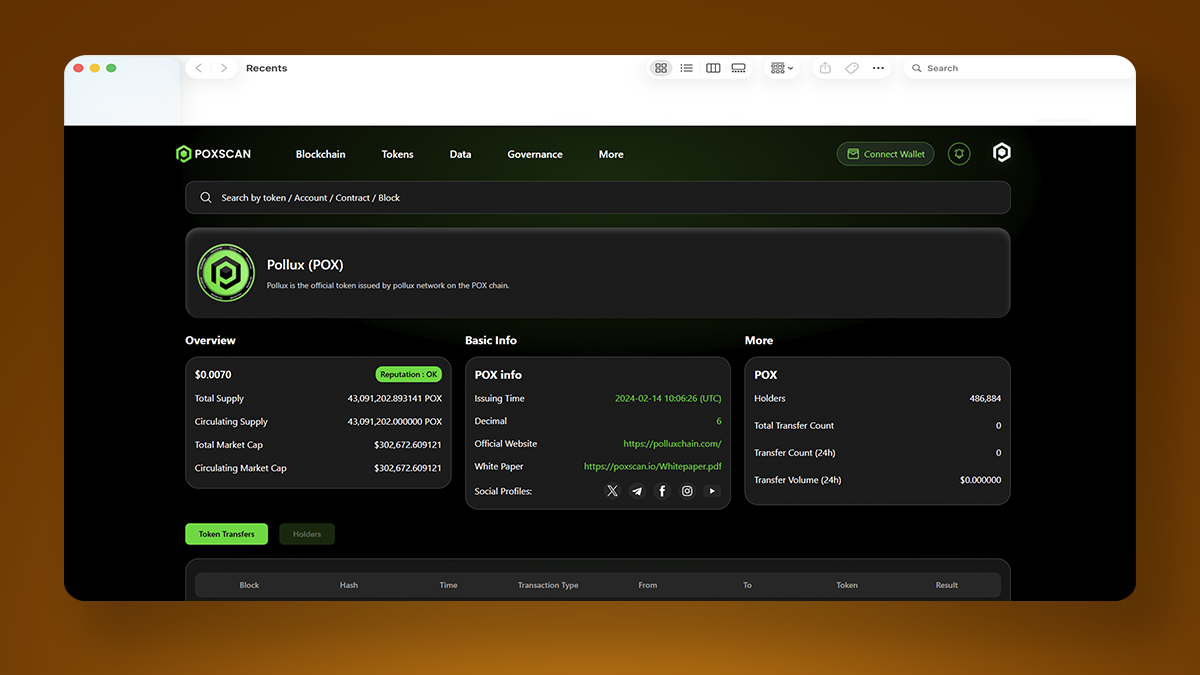
The migration succeeded with zero losses. 49.85 million of 50 million POX migrated, a 99.7% success rate, 32,891 addresses migrated, zero tokens lost, and 100% balance accuracy. Trading resumed on schedule on February 15, 2024, and the migration tracker turned what could have been an anxious process into a transparent one, strengthening community trust.
The explorer exceeded every target by an average of 40%. It achieved 99.92% uptime against a 99.5% goal, with only seven hours of annual downtime, zero data-loss incidents, and zero security breaches. In year one it drew 450,000+ unique visitors and 2.5 million total page views, registered 850+ API developers, and supported 125 dApp integrations, while processing 1.25 million transactions and tracking 45,320 active addresses and 33,176 token holders.
Community sentiment was strong: 92% positive on Twitter, a 4.7 out of 5 community rating, and growing followings across Twitter, Telegram, Discord, and YouTube. For PolluxChain the business impact was concrete: greater transparency cut support tickets by 40%, the API ecosystem supported faster dApp launches, performance benchmarks strengthened market positioning, and improved trading visibility supported price discovery and liquidity. First-year ROI exceeded 400%, with more than $730K in ecosystem value generated, delivered on time in 26 weeks and within a $156K first-year budget.
PoxScan.io continues to evolve through an ongoing partnership, with a roadmap covering mobile apps, AI-powered advanced analytics, enhanced DeFi dashboards, NFT galleries, governance portals, and white-label enterprise solutions, growing alongside the PolluxChain network it serves.
LBM Solutions delivered beyond our expectations. PoxScan.io isn't just a blockchain explorer, it's the cornerstone of our ecosystem. Their technical expertise, professional approach, and commitment to our success made this project a resounding success. The explorer played a crucial role in our mainnet migration and continues to be essential for our community and developers. We couldn't have asked for a better technology partner.PolluxChain Leadership Team, PolluxChain
Building something similar?
Let's scope it.
A 30-minute architecture review with an engineer who has shipped this before. No obligation.
NDA on request.