
Minati
Eight interconnected products, one token-powered Web3 economy, delivered end to end
Launching a multi-product blockchain ecosystem in a crowded, skeptical Web3 market, while building trust, educating users, and attracting investors at the same time.
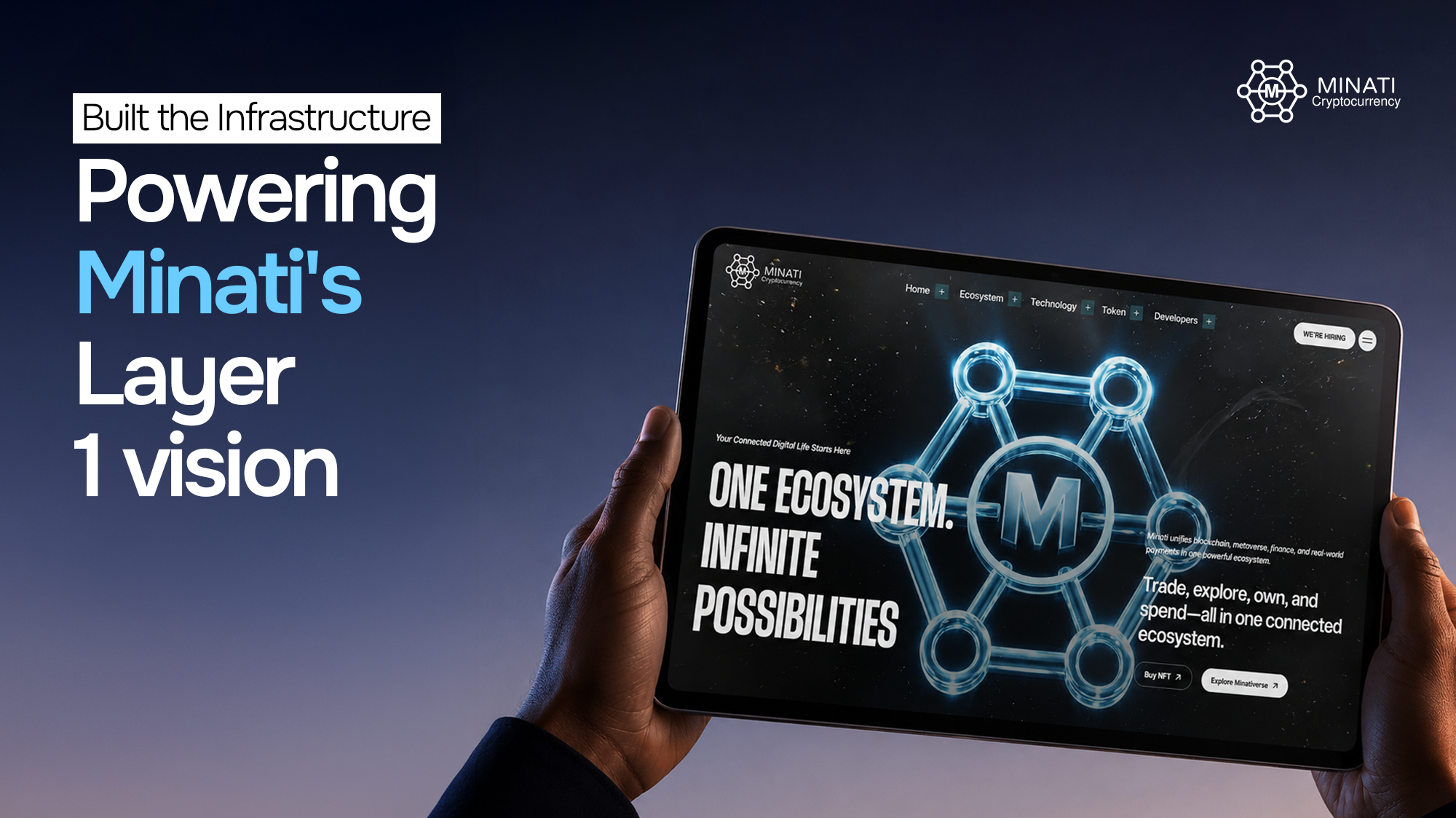
Minati was envisioned not as a standalone cryptocurrency but as a complete, interconnected Web3 infrastructure: a digital economy where users could store, trade, spend, stake, and manage assets through one unified platform. The ambition was bold, to build an entire blockchain ecosystem from the ground up and then position and market it to a global audience. We were brought in as the end-to-end execution partner, handling everything from smart contract development and tokenomics design to whitepaper creation, brand positioning, website development, and a full 360-degree marketing strategy.
The blockchain industry is crowded with single-utility projects: a wallet here, a DEX there, an NFT platform somewhere else. Minati's vision was fundamentally different. The goal was a comprehensive ecosystem where every product reinforced the others, creating compounding utility that no single-feature project could replicate. That ambition came with serious complexity, because building credibility for a simple token launch is hard enough, and doing it for an eight-product ecosystem, each with its own positioning, technical architecture, and user education, is an entirely different challenge.
Six distinct challenges defined the work. Ecosystem architecture: designing a clear, coherent structure connecting multiple products under a single blockchain infrastructure without confusion or fragmentation. A sustainable token economy: engineering tokenomics capable of supporting long-term growth, user incentives, and multi-product utility at once. Investor credibility: professional-grade documentation that positioned Minati as a serious, well-architected project for institutional and retail investors. Audience education: communicating real-world utility beyond speculative trading, to both crypto-native users and newcomers unfamiliar with DeFi. Multi-product awareness: building simultaneous awareness for eight distinct products under one cohesive brand without diluting the core message. And community growth: attracting and retaining an active, informed community at a time when trust in new Web3 projects was at a premium.
Rather than treating technical development and marketing as separate workstreams, we designed a unified execution strategy where every deliverable, from smart contracts to social campaigns, reinforced the same core narrative: Minati is a complete blockchain ecosystem, not just another token. The work moved through four connected phases: build (blockchain development and tokenomics), document (whitepaper and investor materials), launch (website, branding, and rollout), and grow (360-degree marketing and community). By the time Minati reached the market it had a strong technical foundation, compelling documentation, a professional digital presence, and an engaged community, all aligned around a single positioning strategy.
At the core we developed the Minati ERC-20 token, MNTC, on Ethereum, with a smart contract implementation built to the highest standards for security, compatibility, and scalability. MNTC was architected as more than a speculative asset: it is the primary utility layer powering every product, from transaction fees and staking rewards to governance participation and platform services. The work spanned full ERC-20 token development and testing, a security-focused contract architecture to minimise vulnerabilities, a complete deployment pipeline from development through audit-readiness to live mainnet, and a token integration framework defining how MNTC flows across all eight products, so demand is driven by real usage rather than speculation.
A token launch without thoughtful tokenomics is just a lottery ticket. We designed a comprehensive economic framework that balanced short-term user incentives with long-term ecosystem sustainability, built on the principle of utility-driven demand: genuine usage such as staking, governance, payments, and platform services naturally drives demand for MNTC. The model optimised for long-term growth over short-term price action, user-participation incentives that reward real engagement, controlled distribution to prevent early dumping, embedded community-engagement mechanisms, and utility-driven demand across all products. Allocation spanned ecosystem development and treasury reserve, team and advisory allocation with vesting schedules, community rewards and staking incentives, public sale and liquidity provision, and marketing and partnership development.
In Web3 a whitepaper is often the foundation of a project's credibility, so we produced a professional, comprehensive whitepaper that gave technical clarity to blockchain-savvy audiences and a compelling business narrative to investors. It covered six pillars: the ecosystem architecture and how the eight products connect through the shared MNTC infrastructure; a data-backed market opportunity analysis for each product; the technology framework across the blockchain layer, smart contracts, wallet integration, and cross-product token flows; the full economic model with allocation percentages, vesting schedules, utility mechanisms, and demand drivers; governance mechanisms covering proposals, voting rights, and governance evolution; and a phased roadmap from initial launch through full ecosystem maturity with clear milestones.
What sets Minati apart is the breadth of its product suite. Rather than solving one problem well, it was designed to solve the entire journey of a digital asset user, from acquiring and storing assets to spending them in the real world and participating in a virtual economy. Eight products were built to reinforce one another in a self-reinforcing loop, all powered by MNTC: the Minati Blockchain, Minati Coin (MNTC), Minati Exchange, Minati Vault, Minati Crypto Cards, payment infrastructure, the NFT ecosystem, and the Minativerse. Usage of any single product increases demand and circulation of the native token, reinforcing the value of the whole system.
The Minati Blockchain is the decentralised, Ethereum-compatible infrastructure layer that handles transaction validation, smart contract execution, and the core economic logic the rest of the ecosystem relies on. Minati Coin (MNTC) is the native asset and the fuel for every interaction across all eight products: it powers on-chain transactions across the exchange, wallet, payment, and NFT products; users stake it to earn ecosystem rewards, which creates long-term holding incentives and reduces circulating supply; and holders use it for governance, giving the community a direct voice in platform decisions.
The Minati Exchange lets users trade and manage digital assets with ecosystem-native liquidity and a user-friendly interface for all skill levels, with MNTC as the base trading pair and fee token so trading activity creates organic token demand. The Minati Vault is a secure, non-custodial, multi-currency wallet for storing, sending, receiving, and managing assets, with multi-wallet compatibility and seamless integration into the exchange and payment products, making it the natural hub for all MNTC activity.
To close the gap between digital assets and everyday spending, the Minati Crypto Card, available as both a physical and virtual card, converts MNTC and other digital assets into spendable currency at any merchant accepting standard payment networks. A merchant-facing payment infrastructure lets businesses accept MNTC and other cryptocurrencies for goods and services, creating a real-world demand layer where every merchant transaction becomes an ecosystem interaction. Together these products are central to Minati's differentiation, turning MNTC from a speculative asset into a genuinely spendable currency.
Beyond financial infrastructure, Minati extends into digital ownership and immersive experiences. The NFT ecosystem is a fully integrated platform for creating, owning, trading, and monetising digital assets, where NFTs can represent virtual real estate, access passes, governance tokens, and revenue-generating assets, with MNTC powering every NFT transaction. The Minativerse is a virtual environment for digital ownership, social interaction, and commerce, where MNTC is the native currency and NFTs represent real ownership, positioning Minati at the intersection of DeFi, gaming, and the creator economy.
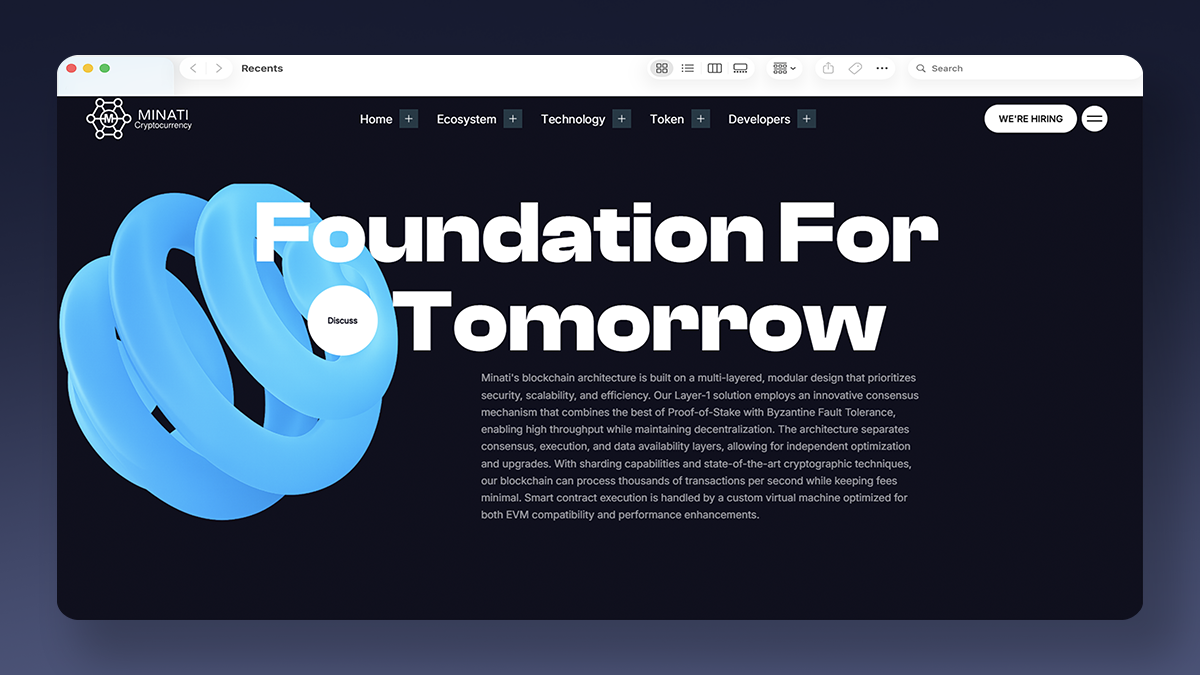
On the brand side, we designed and developed a modern, responsive website that communicated the ecosystem's technical depth to sophisticated investors while staying accessible to newcomers. It was structured around the eight products, each with dedicated positioning, a top-level ecosystem architecture view, interactive tokenomics visualisation, and a phased roadmap. A central early decision shaped everything: Minati would never be positioned as just a cryptocurrency. We built a positioning framework anchored in ecosystem breadth and real-world utility, captured in one statement, a complete blockchain ecosystem where users can store, trade, spend, and grow digital assets through a unified Web3 infrastructure. That shift from token-first to ecosystem-first became the backbone of every piece of marketing, every social post, and every investor communication.
Finally, we designed and executed a comprehensive 360-degree marketing strategy across four interconnected pillars: brand awareness, content marketing, social media marketing, and community building. Because in Web3 education is marketing, we produced a content library spanning blockchain fundamentals, Web3 adoption trends, ecosystem tutorials, and MNTC utility guides, calibrated for both crypto-native and mainstream audiences. We ran a community-first growth programme that treated users as stakeholders, with structured onboarding, regular ecosystem updates, engagement and rewards initiatives, retention strategies, and governance encouragement. Across Twitter, Telegram, and Discord we maintained consistent ecosystem updates and announcements, dedicated product-awareness campaigns for each of the eight products timed around milestones, and a separate investor-focused communication track, supported by a suite of investor materials including presentations, pitch decks, and ecosystem explainers.
Every element of the technology stack was chosen for reliability, ecosystem compatibility, and long-term scalability: Ethereum with a standard ERC-20 token as the foundational layer, Solidity smart contracts for token logic, staking, governance, and NFT standards, multi-wallet compatibility including MetaMask for broad user access, modern responsive web technologies for the website, exchange, and vault interfaces, and a Web3 infrastructure layer for cross-product MNTC flows, dApp connectivity, and real-time blockchain data. Building on a standard ERC-20 implementation gave Minati immediate compatibility with the broadest possible range of wallets, exchanges, and DeFi protocols, dramatically reducing the time to initial ecosystem reach.
The breadth of what we delivered reflects the scale of the ambition. Across six areas, the work spanned blockchain development (ERC-20 token development, smart contract deployment, security-focused architecture, and ecosystem utility planning), tokenomics and economics (a full economic model covering allocation, vesting, utility mechanisms, and long-term sustainability), documentation (a comprehensive whitepaper, investor presentations, ecosystem explainers, and technical documentation), branding and design (positioning strategy, visual identity, UI and UX design, and ecosystem architecture planning), website development (full design and build with product showcases and responsive architecture), and 360-degree marketing (brand awareness, content marketing, social media management, community building, and growth campaigns).
Through this end-to-end partnership, Minati was equipped with everything needed to compete at the highest level: a technically sound ERC-20 token with security-focused smart contract architecture, a sustainable tokenomics model built for long-term growth, professional investor documentation, a modern product-showcasing website, a cohesive brand identity anchored in ecosystem utility rather than speculation, and a comprehensive 360-degree marketing strategy that built awareness, educated users, and grew an active community across every relevant channel.
The result, by the numbers: eight interconnected ecosystem products launched under a single brand and token economy, fifteen distinct services delivered from smart contract development to social media campaigns, and one unified Web3 economy built for long-term growth. Single-utility crypto projects are increasingly commoditised, and the projects that will define the next decade deliver genuine, interconnected utility across a user's whole digital life. Minati is now positioned not just to launch but to grow, a demonstration of what is possible when technical excellence and strategic marketing work in lockstep from day one.
Minati was built with a single philosophy: that the most valuable blockchain ecosystems are those where every product makes every other product more useful. MNTC is not just a token, it is the connective tissue of a complete digital economy.LBM Solutions, On the Minati engagement
Building something similar?
Let's scope it.
A 30-minute architecture review with an engineer who has shipped this before. No obligation.
NDA on request.