
How to Secure Funding for Your Tech Startup: What Investors Want to See
Getting money isn’t easy when you’re launching a new tech company. Just having a good concept won’t catch attention - there are too many people asking for support. Most who don’t succeed aren’t held back by weak ideas, yet stumble on how they explain their value. What draws interest? Fast growth paths, skilled founders, plus plans that show clear direction. Even clever new companies struggle to impress investors without certain basics. Still, there is hope. A full look at what backers really care about can show how to get ready. Here’s how to shape your business so money follows. Start now.
Understanding the Types of Startup Funding
Knowing what kinds of money are out there matters before sharing your business plan. Some funders want fast growth, others prefer steady progress - each has their own goal. When you get how these options differ, picking one feels less like guessing. That knowledge shapes how you talk about your startup, making things sound real instead of rushed.
Venture Capital: A Key Source for Tech Startups
Not everyone chasing money sees beyond venture capital. Some founders fixate on VCs without noticing different paths to cash. Getting backing from venture firms sounds common, yet hardly any young companies land it. Less than one out of a hundred ever do. That makes VC among the hardest ways to get support. Angels look for quick growth potential paired with big payoffs down the road. They care about real customer interest more than just clever design. Proof of demand matters. So does standing apart from rivals. Without momentum or a route to grow fast, talks with investors usually go nowhere.
For instance, Uber and Airbnb attracted venture capital in their early days because they had more than just innovative ideas. Today, Uber has raised over $25 billion in funding, while Airbnb has secured more than $6 billion, proving the power of VC-backed scaling.
Seed Funding and Angel Investors
Seed funding is the initial money a startup gets when it's just beginning. Usually, it comes from angel investors, people who know the industry and invest early for a share of the company. This money helps turn an idea into something real, like a product or service that works. Investors at this point are taking a chance, so they want to see that the startup has a good chance to grow and knows where it's going. CB Insights says that 42% of startups fail because nobody wants what they're selling, so it's really important for founders to show there's a demand early on.
A good way to get it? Look at WhatsApp. Back then, ex-Yahoo staff gave them $250,000 to start. That money went into building the app so people would join in. Because of that growth, they pulled in another $8 million down the road.
Series A Funding: Scaling Up Your Startup
Once a startup gains traction and proves its concept, its next priority is scaling. That’s where Series A funding comes in. Investors at this stage look for a validated product, steady revenue, and a growing user base. The funds raised can expand the team, refine the product, and enter new markets. Startups must show clear potential for long-term success to attract Series A investors.
A good case? Spotify got its first big investment back in 2008. By then, it already worked well and people were using it more every day. That money let them grow fast, bring in skilled workers, go worldwide too. Now there are more than 600 million using it regularly - shows what smart support at the start can do.
Key Factors Investors Look for in a Tech Startup
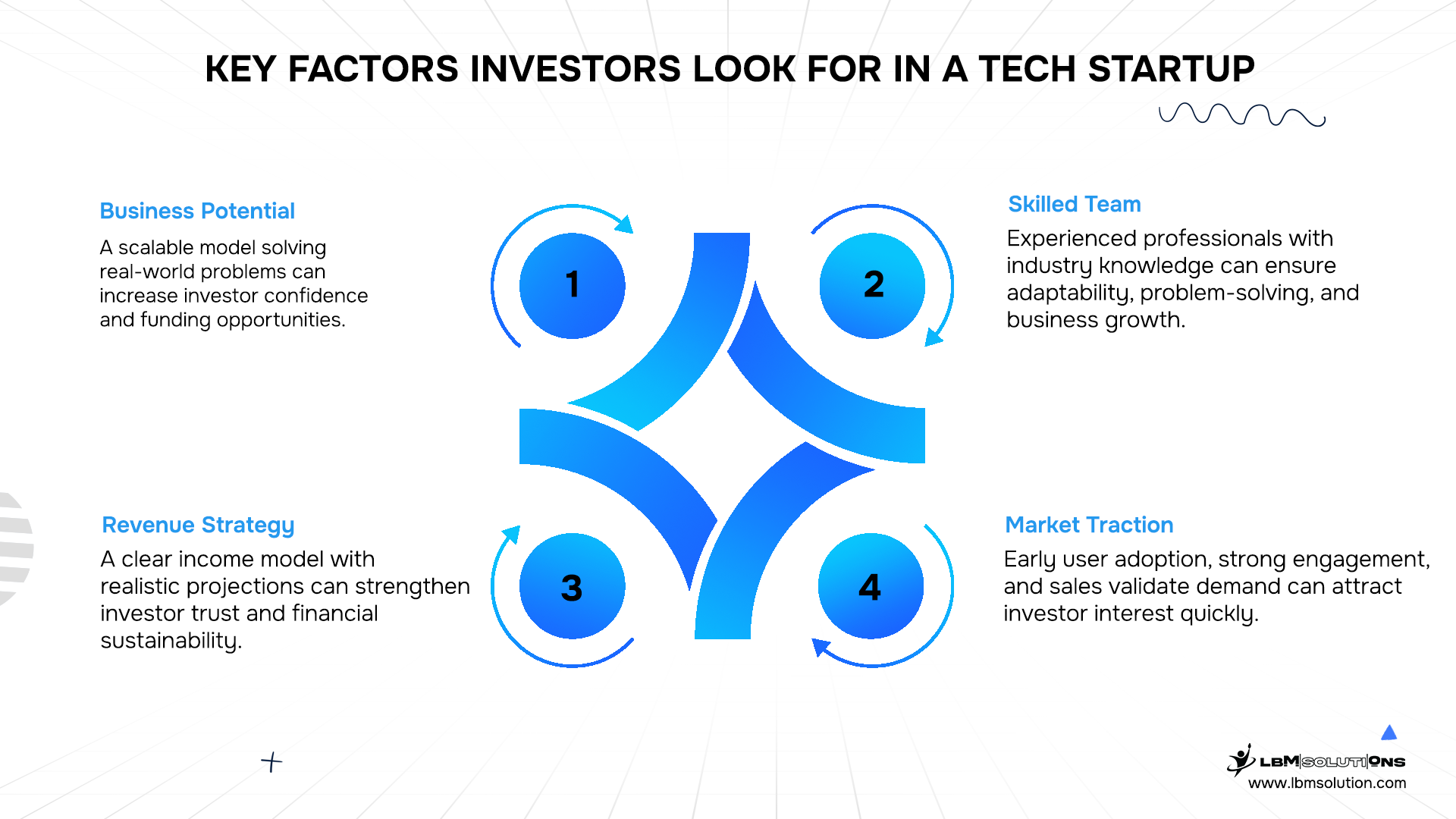
Once you understand funding options, the real challenge begins, getting investors to believe in your startup. They don’t just look at ideas but at execution, market demand, and the team behind it. If they see strong potential, they invest, otherwise they walk away. Let’s learn how to convince them to say yes.
Strong Business Model and Market Potential
Most ideas alone won’t pull in funding. Investors watch for how income flows, whether people actually need what's offered, and if growth is possible. Without proof of earnings and staying power, interest fades fast. Turning something new into lasting value often comes down to smart planning done early.
Take Slack, originally built by a game studio just for their own team. Only after seeing how people actually used it did the creators notice something bigger unfolding. That moment changed everything - suddenly, messaging at work wasn’t about games anymore. A new direction took shape quietly, meeting needs nobody planned for at first. Investors noticed when usage spread fast across offices everywhere. By 2014, that quiet pivot had pulled in $120 million during one funding round alone. Six years from start to billion-dollar status - not bad for software made almost by accident.
A Solid and Experienced Team
It's the people behind a new company who make it work. Watch how investors lean into the founders, not just the idea. Those leading need to know their field inside out, bring skills that matter, move fast when needed. Progress comes from teams that shift gears smoothly, fix what actually needs fixing, keep momentum alive.
Dropbox shows something clear. Not everyone backed it for the tech alone. People trusted Drew Houston more than the idea. He had a way of thinking ahead, plus solid coding talent. That mix made others confident. Growth to billions felt possible because of him.
Clear Revenue Model and Financial Projections
Picture yourself explaining your new company. The moment you start, someone asks, "Where does the money come from?" That answer needs clarity. A believable plan showing how cash flows in makes all the difference when people decide to invest. Think about steady ways to earn - maybe users pay monthly, buy once, or see advertisements. Clarity here matters more than flashiness. When the path to profit is obvious, trust grows. Research shows ventures with straightforward earning methods survive far longer. One report found nearly four out of five made it past early hurdles. Missing this piece? Even brilliant ideas stall before they begin.
Product/Service Validation and Traction
Starting a company? That’s step one. Showing folks actually use your thing - that’s harder. No active users, weak sales, little interaction - investors stay away. They look for signs people truly value your work. When customers jump on board fast, keep coming back, or buy regularly, it signals something real: the market might just care.
A single idea sparked it - snapshots uploaded by hand. Day one brought twenty-five thousand people trying it out. By week eight, a million faces filled the feed. Attention followed fast, then money from those watching closely. Growth kept climbing, step after shaky step, until it stood among giants.
Crafting an Irresistible Pitch Deck for Investors
Once you understand funding options and what investors seek, the next step is presenting your startup convincingly. Your pitch deck is more than slides. It’s your chance to capture investor interest with a clear, compelling story about your business. Startups with a strong pitch deck are 2.3X more likely to secure funding.
Key Elements of a Winning Pitch Deck
A strong pitch deck highlights your startup’s vision, market opportunity, and growth potential, making it easier to secure investment.
Introduction: Start with a strong, concise introduction, explain what your startup does in a single sentence.
Problem Statement: Define the specific issue your target market faces to represent its market impact.
Solution: Present your product or service as an effective response to showcase its uniqueness and competitive advantage.
Business Model: Outline the revenue strategy and define how your company generates and sustains profitability.
Market Size and Potential: Offer market insights, emphasizing scalability and long-term growth opportunities.
Team: Introduce key personnel, relevant expertise and leadership capabilities of your team.
Traction: Provide evidence of market validation through customer acquisition, revenue, or strategic partnerships.
Financials: Present financial projections, outlining revenue forecasts, funding requirements, and allocation plans.
Storytelling in Your Pitch
Numbers alone don’t win investors, but compelling stories do. A real story makes investors pay attention. They want to know what inspired your startup, the challenges you faced, and how you pushed forward. A compelling story builds trust and makes your vision real.
Financials and Projections
Investors want to see the future of your business, not just your vision. A well-planned financial roadmap shows where your company is headed and how it will get there. Solid projections backed by research, expected revenue, expenses, and market potential can build confidence in your vision.
Building Relationships with Investors
A compelling pitch deck captures interest, but securing funding requires ongoing engagement. Businesses must create consistent communication, industry insights, and progress updates to build trust and increase the chances of securing funds when the right opportunity arises.
Networking and Finding the Right Investors
Smart investors bring cash and solid advice and contacts. Going to events or joining investor groups can help you meet folks who get what you're trying to do and can back you up for the long haul. Actually, 78% of startups say meeting people was a big part of why they made it.
Leveraging Accelerator Programs and Angel Groups
Accelerators and angel groups do more than just offer cash. Programs like Y Combinator give you mentors, connect you to people in the business, and give you a plan to grow. Lots of startups have become successful through these programs. This shows that the right advice at the right time really makes a difference.
Negotiating and Closing the Deal
Investor talks can really make or break your company, so you gotta be straight about equity, what you want, and what you expect. Investors like it when you're upfront, so know what you need and offer terms that actually make sense. Once you're all on the same page, write everything down so there are no mix-ups later, and you can build a partnership that lasts.
Common Mistakes to Avoid When Seeking Funding
Many startups struggle to secure funding, not because they lack potential, but due to unclear pitches, unrealistic valuations, or weak financial projections. There are a few common pitfalls you should avoid during your fundraising journey.
Unclear Pitch : Investors lose interest when the problem, solution, and business model are not clearly explained.
Overvaluation Issue : Setting an unrealistic valuation makes investors doubt the company’s actual worth and future potential.
Weak Financials : Projections without supporting data fail to convince investors about the startup’s profitability and sustainability.
Avoiding Questions : Ignoring or dodging investor questions creates doubts about business transparency and management capabilities.
Wrong Investors : Pitching to investors without relevant industry expertise lowers the chances of securing the right support.
Conclusion
Securing funding for your tech startup is a challenging but rewarding journey. Investors look for innovative tech solutions, strong teams, and clear financials.Confidence grows when numbers support what you say. Trust forms through repeated contact over time. Staying ready matters just as much as refusing to quit. Each chat, meeting, or chance encounter pulls funding nearer. Moving forward takes planning plus steady effort. Success comes not from one big moment but many small steps taken consistently.
Planning this work? Start with the crm buyer's guide.
As Chief Technology Officer at LBM Solutions, Manjit Parmar oversees technical strategy, infrastructure, and product development. His expertise in Blockchain and AI enables the creation of secure, data-driven, and scalable systems aligned with business growth and innovation.
Keep reading
SaaS vs AaaS: A Complete Breakdown of Both Models in 2026
Learn the difference between SaaS and AaaS, how AI agents work, and why businesses are shifting toward autonomous software systems.
The Real Guide to AI Real Estate App Development (2026)
Plan your AI real estate app in 2026, features, cost, tech stack & tips to find the right AI real estate app development company.
How Stablecoins Are Replacing Traditional Bank Accounts in 2026
Learn about How Stablecoins Are Replacing Traditional Bank Accounts in 2026. This comprehensive guide covers everything you need to know for beginners.
Build it with engineers.
Product engineering for fintech and SaaS, inside your stack and your repo.