
Post-MVP: How to Plan Your Product Roadmap for Scale
Do you remember? In 2016, Snapchat launched Spectacles, which were smart glasses for instant video recording and sharing. The hype was massive. Over 150,000 units were released into the market. But something went wrong. Only 0.08% of Snapchat’s users bought them, leaving millions of dollars worth of unsold stock. This happens not only with big brands but also with countless startups.
90% of startups fail, with 42% citing a lack of consumer interest as the main reason, as stated in a recent study. The biggest mistake is scaling without a clear plan. But every problem has a solution. Post-MVP planning helps startups create a scalable product development approach. Companies risk feature overload, market misalignment, and technical debt without it. Startups must build products wisely, balancing a tight budget while preparing for sustainable growth. This guide will help you transition from MVP to a full-scale product with strategic planning, market validation, and scalable infrastructure.
What is Post-MVP Stage in Product Growth
Once a company releases its first working version, thoughts shift toward what follows the initial launch. Not every step needs planning upfront, yet direction matters. Picture opening with just sandwiches on offer - simple, quick, tested. When customers keep coming back, choices emerge. Growth might mean broader menus, better spaces, or faster delivery. Expansion does not happen overnight. A cart parked downtown could become something far bigger, given time and clear thinking. Decisions made now shape what comes months later.
However, several startups confuse an MVP with a Minimum Marketable Product (MMP), but they are not the same. An MVP is just a test like selling sandwiches. In contrast, an MMP is a fully developed product ready for the market. Therefore, the post-MVP roadmap focuses on refining features, enhancing user experience, and achieving profitability.
Key Factors to Consider Before Scaling
Many startups fail because they scale too soon. Growth without a solid foundation leads to disaster. A product must prove it fits the market before expansion begins. Otherwise, money, time, and effort go to waste. Here’s post-MVP planning checklist:
Product-Market Fit : A product cannot scale without a proven market fit. Startups must track retention rates, user engagement, and organic growth. If early adopters do not stay, there is no need to scale it.
User Feedback & Data : Founders often assume they know what users want. They should remember that guesswork never works, but data does. Track product launch metrics such as churn rate, NPS, and session duration to guide decisions and get feedback through surveys to ensure alignment with user needs.
Revenue Model : Revenue must grow with the product. Freemium models attract users but may not sustain a business. Subscription-based or transaction-based pricing ensures steady revenue.
Scalability : A product that cannot handle growth will collapse under pressure. Thus, your product must handle increasing traffic, transactions, and users, and your infrastructure, databases, and cloud solutions must be ready.
Sustainable Plan : Scaling requires balancing innovation vs. optimization. Blue Ocean Strategy creates new demand, while Red Ocean Strategy optimizes existing markets. Startups must decide whether to disrupt or improve.
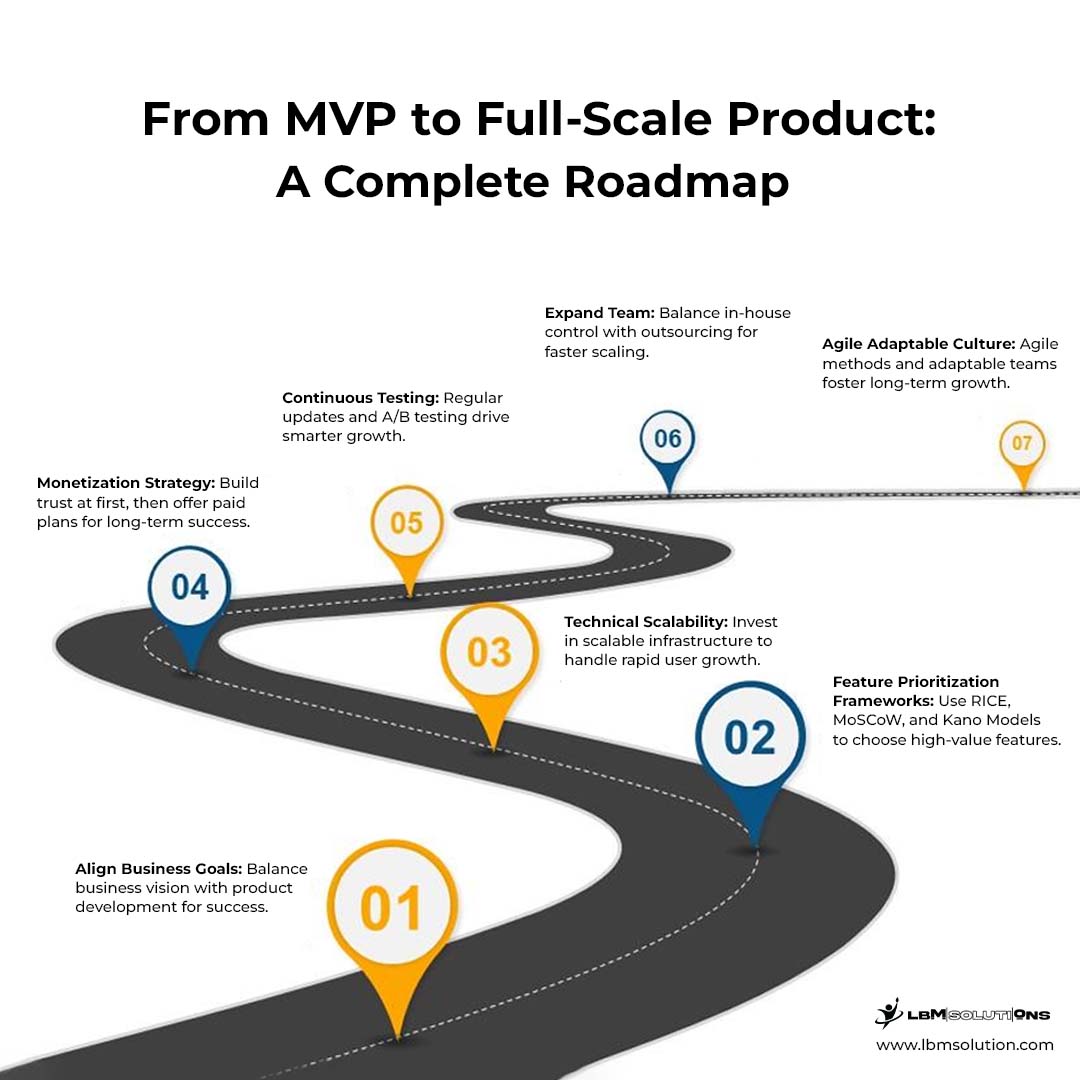
From MVP to Full-Scale Product: A Complete Roadmap
A clear path helps move from a basic version to something that can grow. When you plan how your product enters the market, it stands a better chance of lasting. Here’s one way to shape what comes after the first working model.
A. Aligning Business Goals with Product Development :
Many startups make a common mistake they either chase revenue without improving the product or focus too much on features without a clear business plan. Both approaches fail. A business goal aims at profit, market position, and growth, while a product goal ensures great features and user experience. The right balance between both can drive success.
Take Netflix as an example. In 2011, they split streaming and DVD rentals to boost revenue but failed. Their stocks dropped 77% in months. Later, they listened to the user feedback, fixed the model, and focused on business growth and user experience. This proves that a strong product fuels business success, and a clear business vision keeps the product on track.
B. Feature Prioritization Frameworks :
Confusion often comes when there are too many pieces packed in. Progress shows up more clearly when things get sharper, not fuller. Teams find their way better with a steady structure to lean on. Take Reach, Impact, Confidence, Effort - some use that mix to weigh what moves the needle. Sorting needs into musts, shoulds, coulds, won’ts keeps effort from spilling where it doesn’t matter. Clarity grows when choices narrow.
The Kano Model identifies basic needs, performance enhancements, and delighters that surprise and excite users. Apple applies the same approach to the iPhone launch. Its core functions remain simple, while small delights like Face ID keep users engaged. Smart feature selection prevents bloat, ensuring sustainable growth.
C. Technical Scalability Considerations :
Imagine launching a product that gained thousands of users overnight, and then, suddenly, the system crashes. Pages won’t load, transactions fail, and users leave. This happens when the backend is not ready for scale. In its early days, Amazon lost $100 million in 40 minutes during a 2018 outage due to server overload and infrastructure failure. A single breach can cost millions and break trust forever.
Startups need databases that grow as demand rises. Cloud setups help manage sudden jumps in users. Traffic surges won’t crash things if load distribution works well. Testing how fast systems respond keeps problems away. Encrypting information locks it down securely. Following rules guards against legal trouble. Backups that never fail save critical files. Systems adjusting on their own handle busy times without hiccups. Routine checks spot weak spots before they break.
D. Monetization Strategy Integration :
Most new businesses collapse - money plans fall apart more than nine times out of ten. Imagine this: your phone alerts you to a fresh download, something shiny and promising. Yet right away, without warning, a screen blocks progress until cash is handed over. That moment kills curiosity fast, often leading straight to delete. Losing users like that? A luxury few young companies survive.
Let’s understand with an example of Netflix or Spotify. They hook users with real offers such as endless shows, favorite songs, and no commitment, build trust, and then offer paid plans. Tiered pricing gives options, so people choose the one that suits their requirements. Many companies lock in enterprise deals for bulk revenue. Startups should understand that upselling only works when users love the product. Solve real problems first, then let users happily pay.
E. Continuous Testing & Iteration :
According to CB Insights, over 70% of startups fail because they do not adapt. They launch an MVP and get early users but never refine the product. Without constant testing, features become outdated, user engagement drops, and competitors take over.
Success after the MVP lives through steady tweaks. One way to learn is trying two versions to see which clicks better. Listening closely shows where things frustrate people - early enough to fix them. Sticking to a clear list helps make sure each change means something useful. Far from being just a step, testing shapes how things grow. When real people guide building, results stretch further - faster.
F. Expand Development Team :
Sometimes, a startup hits traction, and its product demand increases. Now, they face a dilemma: Should they hire an in-house team or outsource? In-house teams bring deep product knowledge, faster communication, and long-term commitment. But hiring takes time, and scaling too fast can drain funds.
Out there, companies often turn outside when time and money matter. Some young businesses bring in extra help just for certain jobs - say, building an app or shaping how a screen looks. That move skips slow hiring steps. Yet depending only on outsiders might backfire down the road. Control slips. So holding tight to key tech work inside makes sense. Meanwhile, handing niche parts to experts? It pushes growth forward - but lighter.
G. Building an Agile & Adaptable Culture :
A product that scales needs a team that adapts. Startups often struggle post-MVP because early success does not always guarantee long-term growth. Thus, an Agile development methodology ensures teams stay responsive to market shifts, user feedback, and business goals. For instance, companies like Spotify and Airbnb adopt Agile principles to deliver impactful updates rather than waiting for massive fixes.
Trying new things matters when a team stays open to change. Updates work better if companies use automatic checks, fast delivery systems, continuous data tracking. Success sticks around when people stay alert, shift smoothly, handle surprises well. Tools help, yet how people think makes the biggest difference.
Growth Strategies to Support Scaling
A product launch is only the first step. The next goal is to attract more users, keep them engaged, and explore new markets. New features should improve user experience and add real value. A well-structured product launch strategy ensures steady and sustainable expansion.
User Acquisition : Businesses can use paid marketing, organic SEO, and referral programs to drive new users and performance tracking for cost-effective growth.
User Retention : For long-term user retention, you can enhance user experience, provide excellent customer support, and implement loyalty programs.
Expanding Market Reach : Localization, adapting to new demographics, and international expansion allow businesses to reach broader audiences and sustain growth.
Partnerships : Founders can collaborate with industry leaders, integrate APIs, and adopt third-party tools to expand functionality and accelerate scalability.
Conclusion
To conclude, scaling after an MVP requires a structured roadmap. Startups must validate demand, refine features, and balance growth with sustainability. Without a Post-MVP roadmap, businesses risk premature scaling, technical failures, or financial collapse. Moreover, a strategic product development strategy can accelerate the process and ensure sustainable expansion in competitive markets. With the right approach, startups can avoid common challenges and focus on delivering value to users. They can stay agile, iterate based on feedback, and align with market demands for product success. If you want to scale your product, you can partner with a strategic software development partner to create a product launch roadmap that accelerates your success.
Planning this work? Start with the crm buyer's guide.
As Chief Technology Officer at LBM Solutions, Manjit Parmar oversees technical strategy, infrastructure, and product development. His expertise in Blockchain and AI enables the creation of secure, data-driven, and scalable systems aligned with business growth and innovation.
Keep reading
SaaS vs AaaS: A Complete Breakdown of Both Models in 2026
Learn the difference between SaaS and AaaS, how AI agents work, and why businesses are shifting toward autonomous software systems.
The Real Guide to AI Real Estate App Development (2026)
Plan your AI real estate app in 2026, features, cost, tech stack & tips to find the right AI real estate app development company.
How Stablecoins Are Replacing Traditional Bank Accounts in 2026
Learn about How Stablecoins Are Replacing Traditional Bank Accounts in 2026. This comprehensive guide covers everything you need to know for beginners.
Build it with engineers.
Product engineering for fintech and SaaS, inside your stack and your repo.