
What is the Difference Between NFT Vs. SFT
Have you ever held a concert ticket that turned into a digital badge after the event? Now, you are thinking, how is it possible? But it is! The world of Web3 assets, where ownership meets innovation. However, not all tokens are built the same, which makes it possible. In this space, two powerful players emerge: NFTs (Non-Fungible Tokens) and SFTs (Semi-Fungible Tokens). They may sound similar, but they serve different purposes, and understanding their roles and differences helps startups plan their digital product strategies smartly. NFTs represent unique assets, whereas SFTs offer a middle path with flexible use. Whether you are founders, NFT creators, or enthusiasts who want to build a digital product, plan a Web3 platform, or just explore new possibilities, this is your smart way to adopt the future of digital ownership. This blog explains what NFT stand for and what SFT is, delineates how each token works, where they fit best, and why this knowledge matters when building future-ready platforms.
What Do NFTs (Non-Fungible Tokens) and SFTs (Semi-Fungible Tokens) Mean?
A Non-Fungible Token represents a unique digital asset that cannot be copied, interchanged, or divided. It is like owning an autographed baseball card or a custom-made necklace, but made on blockchain. Even if others have similar cards or jewelry, yours has a special story or value tied to it. In digital terms, NFTs can be owned as a limited-edition digital asset from the artist, all verified and stored securely on the blockchain. A non-fungible token example includes Beeple’s “Everydays: The First 5000 Days,” sold for $69 million as a one-of-a-kind digital artwork.
On the other hand, SFT is a digital token that works in two ways: interchangeable like regular tokens but becomes non-fungible once it is used or owned. At first, it acts like a normal token in the form of a concert ticket or a game pass that many people can use. But after someone uses it, it becomes a special item that belongs to that person only, just like a badge or memory. This makes it both useful and unique at the same time.
NFTs Vs SFTs: What Founders Need to Know?
Every digital asset tells a story. NFTs speak of uniqueness as a standalone entity with its own identity. Conversely, digital SFTs tell about different narratives that offer both individuality and the power of quantity. Founders have to make a crucial decision here. The choice between NFTs and SFTs defines how users engage, trade, and experience value on the platform. The core differences between NFTs and SFTs help drive smarter decisions at both the product and business levels.
Key Differences Between NFT & SFT
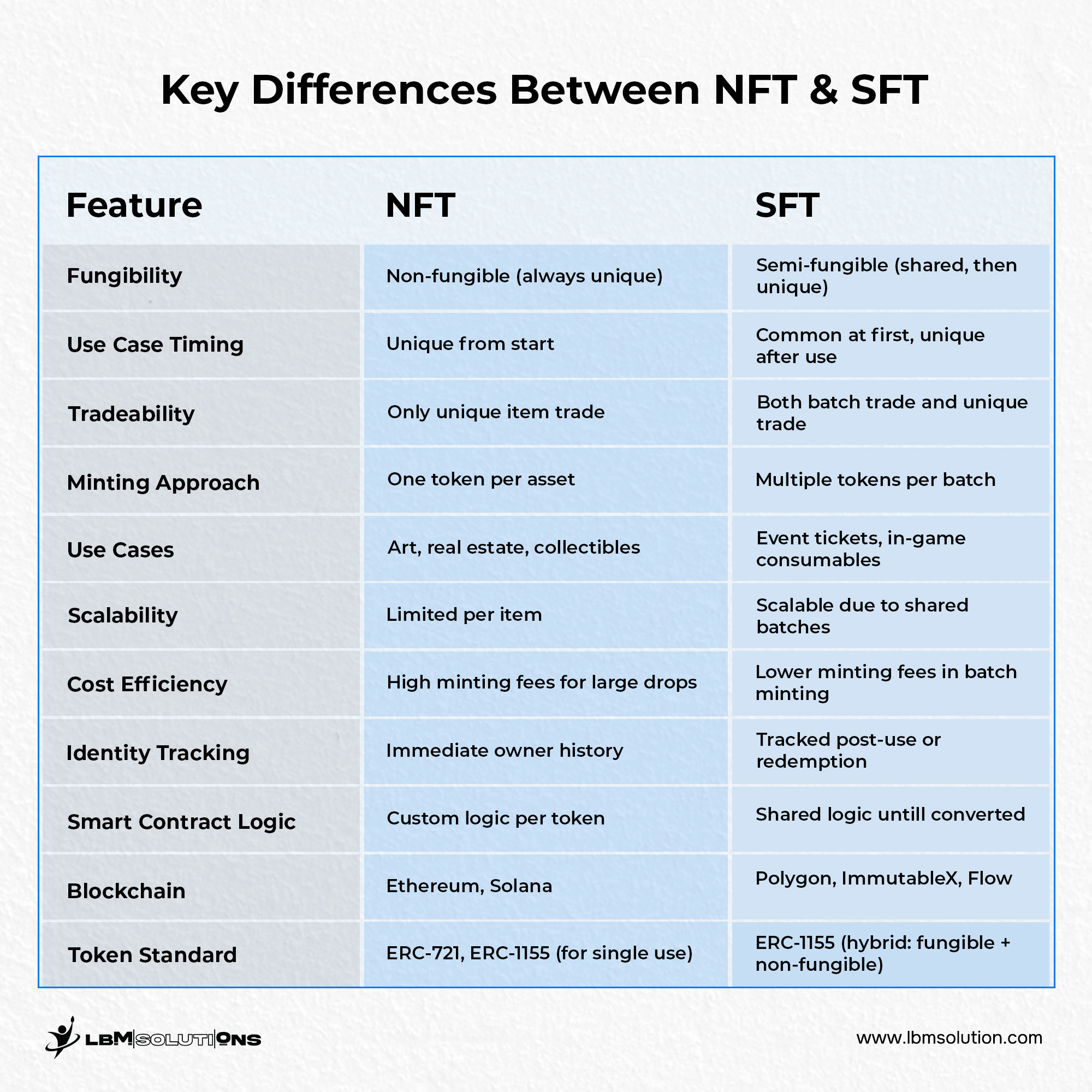
Use Cases of NFT and SFT Explained Simply
NFTs are suitable rare assets. SFTs fit better where quantity matters. Each supports a different kind of value. Founders must see where these use cases align with their product vision and goals.
NFTs for Digital Ownership Rights
Whether it’s a piece of digital art, a music track, a virtual land parcel, or even a tweet, NFTs turn digital files into collectible, ownable treasures. Different from cryptocurrencies like Bitcoin or Ethereum, which are identical and interchangeable, each NFT carries its own value and identity.
Digital Art Ownership : Digital art is no longer “cool visuals”. It is legit property. NFTs help artists sell original digital art with verified ownership and earn royalties. Buyers receive proof that the artwork is authentic, not just another online copy.
Music Rights & Albums : NFTs allow users to buy a track that nobody else has. Musicians can drop special tracks or albums as NFTs without middlemen and earn profits. Fans who purchase them own a unique version and support artists directly.
Virtual Real Estate : Land in the metaverse sounds wild until you see people building actual homes, shops, galleries, and hangout spots. Owners can create, sell, or lease digital properties as NFTs, just like in real life, but on the blockchain.
Domain Names : Some domain names work like digital property and are stored as NFTs. Once purchased, they belong to the owner permanently and provide full control without relying on third-party registrars, as Web3 isn’t renting space from the internet.
Identity Tokens : It is tiresome to log into every app with different passwords. NFTs turn your identity into something portable and verified. Certain platforms issue identity tokens and allow users to log in and prove who they are across apps.
SFT Use in Different Applications
In digital space, not every digital token stays the same, some are evolved, and that’s where Semi-Fungible Tokens (SFTs) stand out. SFTs work as digital shapeshifters. They are useful today and meaningful tomorrow.
Gaming Consumables : Game developers can create special potions or weapons as SFTs. Players can trade them across games. Once used in gameplay, the item becomes locked and reflects the player’s unique journey and experience.
Loyalty Points : Brands issue SFTs as loyalty points that work like digital cash. Customers can trade or redeem these tokens across platforms and partner brands. Once used, the token permanently links to that specific transaction or customer profile.
Event Passes : Event organizers tokenize ticket entries using digital SFTs based on seat type, access level, or perks. All tokens carry similar utility before the event. After scanning, the token records personal attendance and turns into a digital memento for the user.
In-App Purchases : Mobile and web apps issue SFTs to bundle premium features, character skins, or toolkits. After activation, each SFT reflects user-specific choices and actions and preserves a personalized experience trail within the app.
Collectible Cards : Digital collectible platforms launch cards as SFTs during seasonal drops or promotional events. These cards circulate freely in secondary markets. When someone claims, it converts into an NFT that reflects the collector's identity.
Why Should Business Owners Care?
Token selection sets the tone for product utility, user retention, and future monetization. Every decision around NFTs or SFTs shapes digital experiences, influences cost structures, and unlocks scalable engagement models. However, founders must know the right format at the right time to create better products, stronger brands, and smarter operations.
New Revenue Streams : One sale shouldn’t be the end of the story. NFTs and SFTs create lifetime earning potential. Every resale sends money back to the original creator, while digital scarcity makes each drop feel exclusive and valuable.
Customer Engagement : Traditional loyalty programs feel outdated. SFT-based loyalty programs offer more than points. They give users something to chase, something to brag about, and a reason to keep coming back.
Proof of Authenticity : NFTs confirm true ownership and ensure every digital asset remains traceable and original. This approach eliminates counterfeit risks for items like art, event tickets, or membership passes.
Smart Automation : Smart contracts control token conditions without human effort. Business operations become smoother and more reliable as expiry dates, usage limits, or resale permissions of NFT are activated without human input.
Asset Tokenization : Businesses can transform physical assets like merchandise, artwork, or exclusive experiences into digital tokens. These assets gain liquidity and become tradeable within secure digital marketplaces.
Data Transparency : Blockchain stores the complete history of each token. Customers trust the openness, and businesses gain actionable insights from user interactions, ownership timelines, and usage behavior.
Choosing the Right Token for Your Business
Founders often face one big question: how to pick the right token for their business. The answer depends on what kind of value they want to give to users. They can use NFT development when every item needs to feel different. These tokens are best for digital art, event tickets, or certificates. For instance, Beeple’s digital artwork was sold as a single NFT and made global news. It showed how one unique digital item can hold a large value.
Moreover, SFTs can be developed when businesses want to send large numbers of items that later become unique. These tokens work well in games, rewards, or virtual goods. The popular game Gods Unchained gives out thousands of cards using SFTs. All cards look the same at first. After players use them, the cards change and take on a unique form.
Some smart business owners utilize their combination. They adopt semi fungible token development to give early access. Later, they shift to NFTs when users find something personal. This provides the business with both wide reach and strong personal value. Let’s take the example of Ubisoft, a leading game company that used a smart mix of SFTs and NFTs in its Quartz platform. For large-scale in-game items, they chose SFTs, and for limited-edition drops or player-specific items, they switched to NFTs. This approach gave them both wide player reach and strong personal value.
Final Thoughts
Both NFTs and SFTs are significant in providing digital ownership in Web3. While NFTs lock in uniqueness from the start, SFTs begin with shared value and shift to individuality after interaction. Founders and startups can now plan token-based solutions with clarity. Each type solves a different problem. While one helps build brand value through originality, the other handles utility at scale. As more platforms embrace Web3 assets, understanding the basics of and difference between non-fungible tokens and semi-fungible tokens helps businesses, creators and artists to avoid confusion later. The time to act is now. Whether you are building a gaming platform, an event app, or a digital art NFT marketplace, you can choose the token that fits your business model. You can also hire a trusted NFT development company to launch your vision right.
Planning this work? Start with the token launch guide.
As Chief Technology Officer at LBM Solutions, Manjit Parmar oversees technical strategy, infrastructure, and product development. His expertise in Blockchain and AI enables the creation of secure, data-driven, and scalable systems aligned with business growth and innovation.
Keep reading
SaaS vs AaaS: A Complete Breakdown of Both Models in 2026
Learn the difference between SaaS and AaaS, how AI agents work, and why businesses are shifting toward autonomous software systems.
The Real Guide to AI Real Estate App Development (2026)
Plan your AI real estate app in 2026, features, cost, tech stack & tips to find the right AI real estate app development company.
How Stablecoins Are Replacing Traditional Bank Accounts in 2026
Learn about How Stablecoins Are Replacing Traditional Bank Accounts in 2026. This comprehensive guide covers everything you need to know for beginners.
Build it with engineers.
Compliance-aware token systems, built and audited by senior engineers.