
ICO Development Solutions for Entrepreneurs: A Roadmap to Digital Funding
Big dreams sometimes stall before reaching people simply because money runs short, particularly when new companies face tight budgets. These days, entrepreneurs skip old paths such as banks or venture capitalists - routes filled with delays and layers of approval. A different route appears: launching an Initial Coin Offerings lets firms collect support straight from interested users without detours. This method opens doors once locked by slow paperwork and gatekeepers
A report from Statista in 2024 showed that ICOs brought in more than $12 billion globally, signaling a major change in how founders gather funds. Instead of old-school routes, companies now turn to ICOs for fast access to money while skipping usual limits and connecting with backers across borders. Yet what exactly is an ICO? What steps build one successfully? Inside these lines lies a clear breakdown along with a practical path forward - meant for leaders, entrepreneurs, and those shaping digital investment choices.
What Is An ICO (Initial Coin Offering)?
Starting off, an Initial Coin Offering means selling digital tokens to get money from people. Getting support this way skips banks or investors most of the time. Money flows in when buyers trade their cash for these new coins. Companies choose it to stay independent from old-school finance setups. Some see it as a fresh path to gather resources quickly. Not every project uses it, yet plenty find value outside normal channels
Think of an ICO as handing out vouchers for a yet-to-open diner. Early backers chip in money hoping for something back later on. Instead of giving pieces of ownership, founders pass out digital coins to gather funds. These tokens act more like access keys than stock.
What is ICO Development? Why Entrepreneurs are Turning to ICOs
ICO development is the process of creating and launching an Initial Coin Offering, including designing the token, developing the platform, and preparing marketing strategies. This funding method gains traction. Thus, founders prefer them to reduce traditional barriers and enter into global crypto markets.
Global Access: This approach allows businesses to tap into a worldwide group of investors and enables fundraising efforts without geographical restrictions. This global access expands the potential for capital generation and attracts diverse investors.
No Middlemen: It removes the need for intermediaries like banks or brokers. Entrepreneurs connect directly with investors, minimize costs, and eliminate delays commonly associated with traditional fundraising methods.
Faster Fundraising: With ICOs, founders can raise funds in less time than traditional methods. Crowdfunding through tokens allows for capital to be secured in weeks and speeds up the entire fundraising process.
Community Building: Businesses can build a community around their project. Moreover, investors can become early stakeholders, offer valuable feedback, and support for long-term success and the project’s growth.
Token Utility: Tokens offer actual value in the project’s ecosystem and hold utility beyond just being an investment. Businesses can design tokens to serve a function within their platform, which adds value and utility to the offering.
Flexible Funding Structure: This method assists in selecting between a fixed token price or a dynamic pricing model, depending on their goals. This flexibility is helpful to various types of businesses and market conditions.
A Step-by-Step Roadmap for ICO Development
A successful ICO begins with a clear vision and a structured path. Each phase provides new opportunities for growth, innovation, and funding. This roadmap helps leaders understand crucial steps, avoid common pitfalls, and build trust with potential investors.
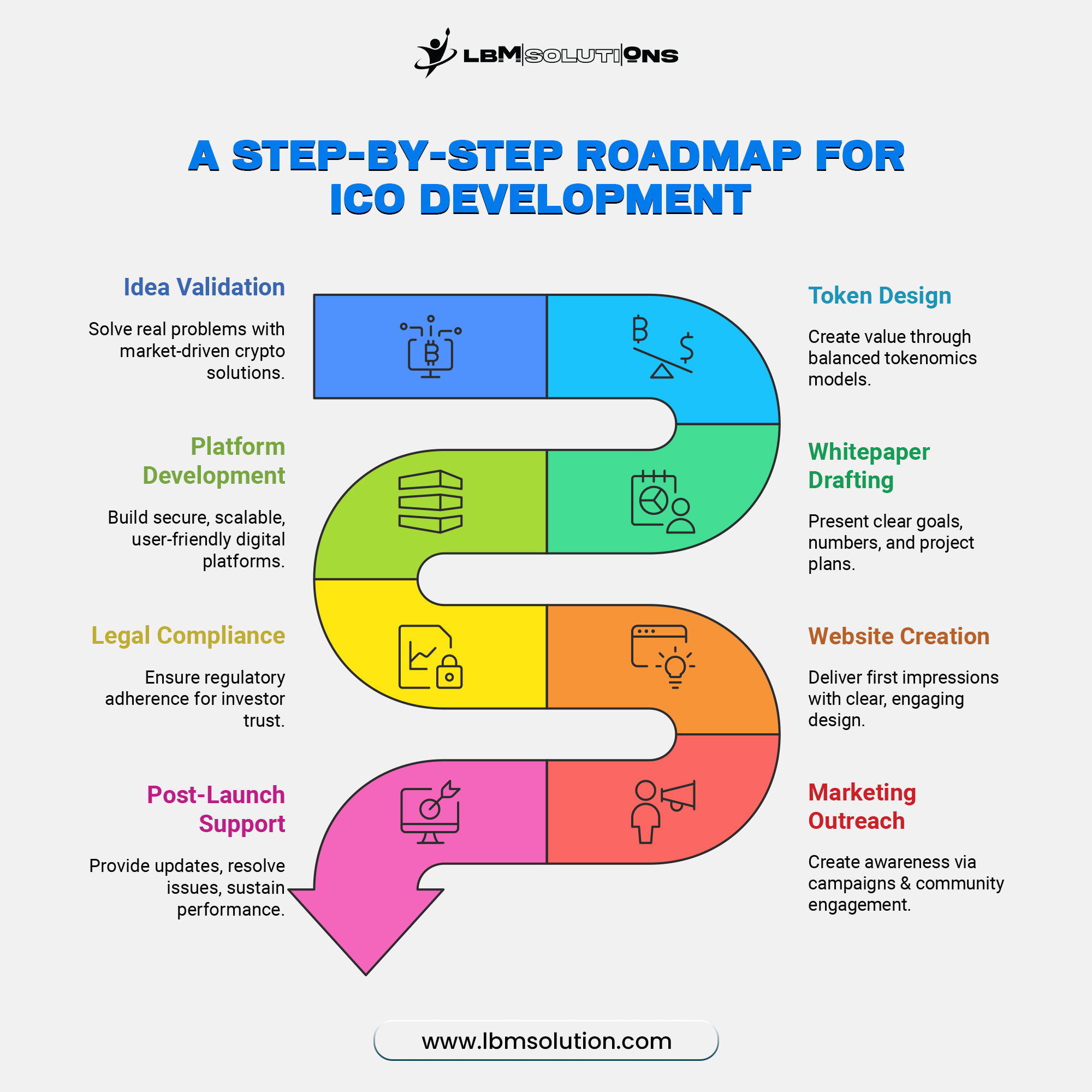
Idea & Market Research: Every great business starts with a simple question: “Does the world need this?” ICOs are no different. A strong concept solves a real problem. Imagine opening a coffee shop in a tea-loving town, and it would not fail. The same goes for crypto projects. You have to understand the market, competitor offerings, and target audience needs to guide the ICO development and strategy.
Token Model Design: After the market analysis, the next step aims to design the token model. Smart tokenomics acts like a well-balanced menu, which offers value, variety, and purpose. A project with clear supply limits, a distribution mechanism, investor rewards, and utility of the token within their platform stands out. A well-designed token model ensures long-term success.
Whitepaper Creation: Can a business idea succeed without showing numbers, goals, or plans? Absolutely not! The whitepaper serves as the foundation for an ICO, because investors don’t bet on mystery; they invest in clarity. It outlines the project's vision, goals, and token economics. A well-crafted whitepaper provides a clear understanding of the project to establish trust and transparency.
Platform Development: A secure and user-friendly platform becomes your digital storefront. Customers will not react to a shop with flickering lights and poor service. Therefore, a secure and scalable platform is essential for the ICO. Entrepreneurs need a robust infrastructure that can handle large volumes of transactions, ensure data security, and offer an intuitive user experience.
Legal & Regulatory Compliance: Every successful ICO stands on legal ground. A taxi service without a license can get a few rides, but not grow. Legal clarity builds investor confidence and long-term safety for the team. Founders must consult with legal professionals to ensure the ICO meets both local and global regulatory standards and avoids potential legal issues.
ICO Website Development: Your website becomes the first impression and the handshake before the pitch. No investor wants to scroll through a confusing, slow-loading site. A clear website design with strong messaging and a security-first approach is necessary to provide information about the project, the token sale process, how investors can participate, and build credibility.
Marketing and Community Building: Even the best product fails in silence. Marketing efforts before and after the ICO are essential for generating awareness and engaging the community. Pre-ICO marketing campaigns create anticipation, while post-ICO efforts help maintain investor interest and sustain the project’s progress.
Launch and Post-Launch Support: The launch does not end the journey, but starts the story. Timely responses, updates, and support keep users loyal. Thus, successful ICO launches require ongoing support. Businesses must offer continuous updates to investors, monitor performance, find and resolve bugs, and ensure the platform operates smoothly after the token sale concludes.
Types of ICOs: Public, Private, and Hybrid
Not every coin offering looks the same. Some open wide, others stay closed, a few mix both. Each shape fits a purpose - who shows up matters just as much as how much comes in. Deciding which path works ties back to what kind of money they need, how bold they can be, and who they want watching closely.
Open to all, an ICO lets interested people join without limits, offering everyone the same chance at tokens. With no gates or filters, it pulls in diverse backers, sparking momentum fast. Take Ethereum - its launch pulled in more than 18 million dollars, shifting how digital currency evolved. By being transparent from day one, these projects gather real interest, forming groups of active users before anything is fully built.
Public ICO: A public ICO welcomes anyone who wants to invest and gives equal access to tokens. This approach attracts a wide pool of supporters and builds early progress. Ethereum set a famous example for ICO. It raised over $18 million and transformed the crypto world. Such openness not only raises funds but also helps build a strong community around the crypto project.
Private ICO: A private ICO focuses on a selected group of investors, often venture capitalists (VCs) or high-net-worth individuals. This strategy creates rarity and secures larger investments in advance. For instance, Tezos successfully used this approach and conducted a private sale before launching its public offering. Limited access can raise funds quietly while preparing for a larger market launch.
Hybrid ICO: A kind of ICO combines public and private phases and balances broad participation with strategic backing. This model brings the best of both worlds and enhances stability and reach. To illustrate, Polkadot raised over $145 million through a mix of private and public rounds as a fundraising approach. The integrated audience helps projects manage risk and gain capital and credibility.
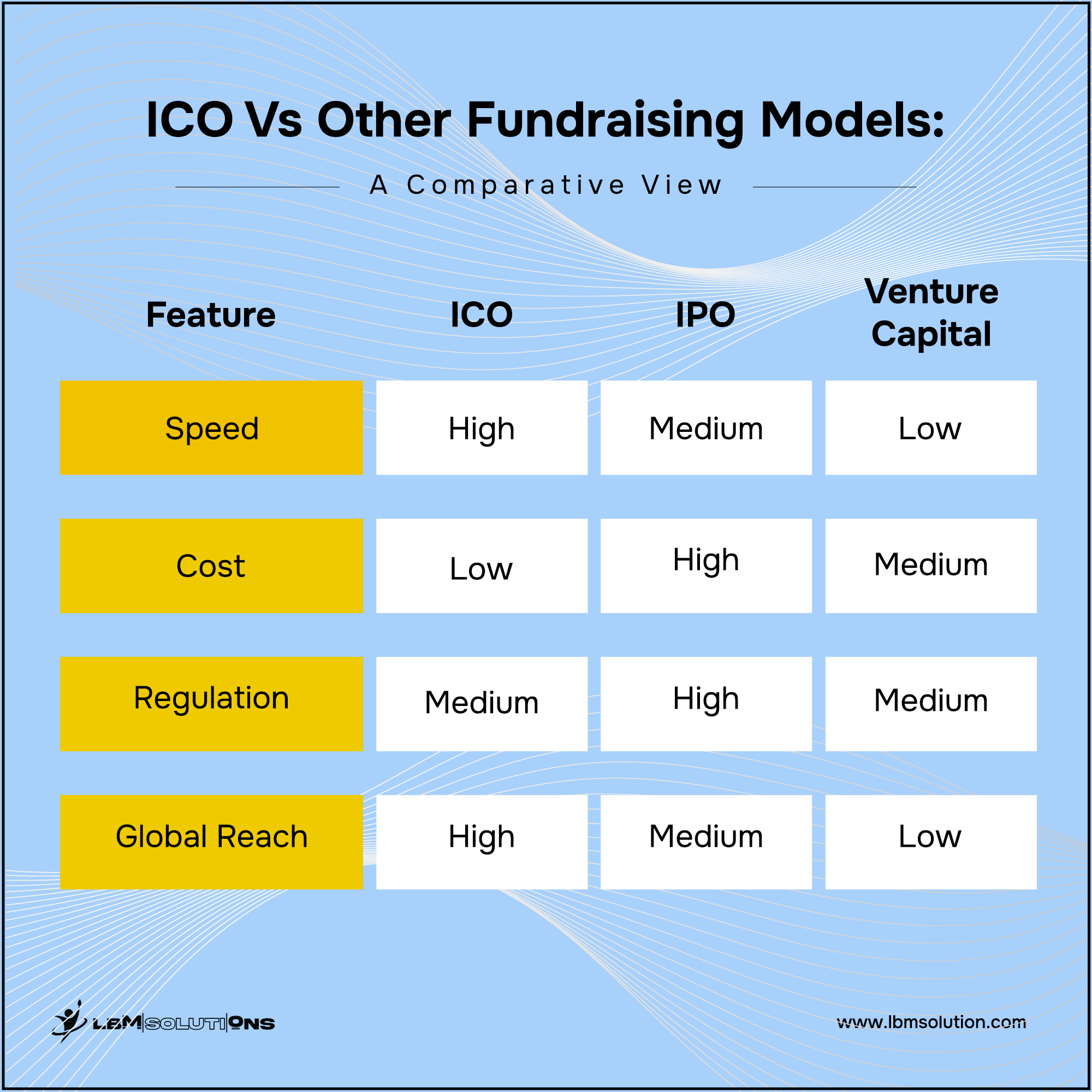
ICO Vs Other Fundraising Models: A Comparative View
Money moves differently now. Raising it can happen quick, touching people everywhere without old hurdles. Going public used to mean selling stock through an IPO - a one-time offer when a firm steps into the open market. Backing startups once relied on venture cash, where funders claim part of a young company instead. Rules weighed heavier before, expenses piled up easier. Getting money either way takes a lot of time plus costs more than expected. Because of that, how a company decides to fund itself really matters.
Cost Breakdown: What Does It Take Financially?
A fresh start means mapping every dollar early on. Costs like lawyers, building tokens, spreading the word, or coding the system shape what you’ll need financially across tech, law, outreach, and safety nets. When pricing feels solid, leaders move forward without second-guessing - each phase gains stability because of it.
Legal & Compliance: Legal fees typically range from $30,000 to $70,000. It covers KYC and AML processes, drafts terms, and secures regulatory approvals. Strong legal foundations give projects the credibility and protection to operate confidently across major markets.
Token Development: The cost to build a token on Ethereum or similar blockchains usually lies between $10,000-$30,000, with respect to the complexity of smart contracts. A well-built token becomes the backbone of the ICO to build trust.
Marketing & PR: Marketing and PR are vital for ICO success. Marketing budgets often stretch from $40,000 to $150,000, covering everything from community-building campaigns to PR outreach and influencer collaborations.
Security & Auditing: Security and auditing are necessary for the ICO platform’s integrity and aligning the smart contracts and platforms with global standards. Security audits typically cost between $10,000 and $50,000, according to the scope of the audit.
Platform & Tech: ICO platform development, including the ICO dashboard and wallet, usually ranges from $30,000 to $80,000, based on features and user experience (UX) requirements. It improves investor confidence and drives smooth project operations.
How to Choose the Right ICO Development Partner
The professional ICO development company makes all the difference. What sets one firm apart is real expertise. Not just experience - know-how that cuts through confusion. With solid legal backing and proven results, progress feels less like guessing. Shared vision matters more than promises. When challenges come, it's trust that keeps things moving. Turning concepts into something tangible takes patience plus precise effort.
Experience And Portfolio: Top ICO development partners with a solid track record and a strong portfolio bring confidence to the table. Their proven success in past ICOs shows an ability to handle challenges and deliver results that matter.
Technical Expertise: They must have skilled ICO developers with deep expertise in building secure smart contracts, scalable platforms, clean UIs, and blockchain development. It ensures that the ICO platform is secure and scalable.
Legal & Compliance Support: The hired ICO team must provide legal guidance to confirm the project complies with local and international laws and reduce the risk of regulatory issues.
End-To-End Support: They must provide complete support across planning, development, marketing, and post-launch needs. Full coverage across these areas keeps the project on track and reduces stress.
Customization & Scalability: Flexible development allows startups to tailor ICOs to business goals, with scalability in mind for future growth. Customizable solutions make sure the platform adapts smoothly to new demands.
Client Testimonials: Reviews from real clients and case studies reveal the work quality and communication standards of the company. Trustworthy partners must have positive feedback from past clients.
Future of ICOs: Trends to Watch in 2025 and Beyond
Ahead lies a path shaped by faster code, clearer rules, new buyer needs. Firms notice shifts like these open doors to better funding ways. What comes next? Patterns forming now will shape how money moves in token sales:
Stronger Regulatory Clarity: Governments now create clearer ICO rules and bring greater safety for issuers and investors. This clarity builds stronger trust in the market and a better foundation to innovate confidently while staying within legal frameworks.
Rise of STOs: Security Token Offerings (STOs) have a more regulated approach to fundraising compared to ICOs. Hybrid models combining ICO and STO elements are gaining popularity, as they combine the best of both worlds.
Focus on Utility and Value: The days of hype-driven investment fade as investors seek real-world use cases and practical benefits. ICO projects with clear roadmaps and meaningful utility rise above the noise. Additionally, strong fundamentals increasingly define success.
Stronger Community Engagement: Communities now play a central role in driving success. Transparent communication builds trust, and genuine user involvement increases loyalty. Projects that prioritize engagement create resilient networks.
Tech Innovations: AI and Layer 2 technologies enhance the project management, sharpen security, and improve marketing impact. This fusion with blockchain also strengthens the core of ICOs and makes the projects more adaptive and ready to meet future demands.
Final Thoughts
Starting up now has a new path thanks to digital times - some firms raise money through ICOs. Getting support from people worldwide happens fast, skipping slow old systems. Early bets on fresh ventures attract those looking beyond price swings alone. When rules, code, and outreach work together, attention stays steady across each phase. Still, making it work means being open, believable, leaving room for people to jump in early. How things roll at each point builds how much backers believe, whether the crowd warms up to it. Choices matter a lot, more than most realize. A solid team behind the launch knows what traps to skip, has seen similar paths before, keeps problems small. What lies ahead for raising funds could favor anyone bold enough to step into new online methods without hesitation.
Planning this work? Start with the token launch guide.
As Chief Technology Officer at LBM Solutions, Manjit Parmar oversees technical strategy, infrastructure, and product development. His expertise in Blockchain and AI enables the creation of secure, data-driven, and scalable systems aligned with business growth and innovation.
Keep reading
SaaS vs AaaS: A Complete Breakdown of Both Models in 2026
Learn the difference between SaaS and AaaS, how AI agents work, and why businesses are shifting toward autonomous software systems.
The Real Guide to AI Real Estate App Development (2026)
Plan your AI real estate app in 2026, features, cost, tech stack & tips to find the right AI real estate app development company.
How Stablecoins Are Replacing Traditional Bank Accounts in 2026
Learn about How Stablecoins Are Replacing Traditional Bank Accounts in 2026. This comprehensive guide covers everything you need to know for beginners.
Build it with engineers.
Compliance-aware token systems, built and audited by senior engineers.