
Building a Software Product on a Tight Budget: Cost-Saving Strategies for Startups
A startup founder really wants to make a software product that people will love. They have an idea and know what they want to do but then they start thinking about how much it will cost to make the software. The cost is a problem because they do not have a lot of money to spend. They are scared that they will fail.. The startup founder is not the only one who has this problem. A lot of startups have trouble making a product when they do not have a lot of money. Actually a lot of software projects fail, up to 60% of them because the people making them did not plan well and did not have money, which is a big problem, for software projects. But here is the good news: it is possible to create a quality software product without breaking the bank. This blog will explore the major factors that affect software development costs and provide practical strategies to reduce costs while building software products.
Key Factors Impacting Software Development Cost
Various factors influence the cost of developing software. These factors can help businesses manage and reduce their overall expenditures. Let’s explore each of these factors to understand how they impact your expenses.
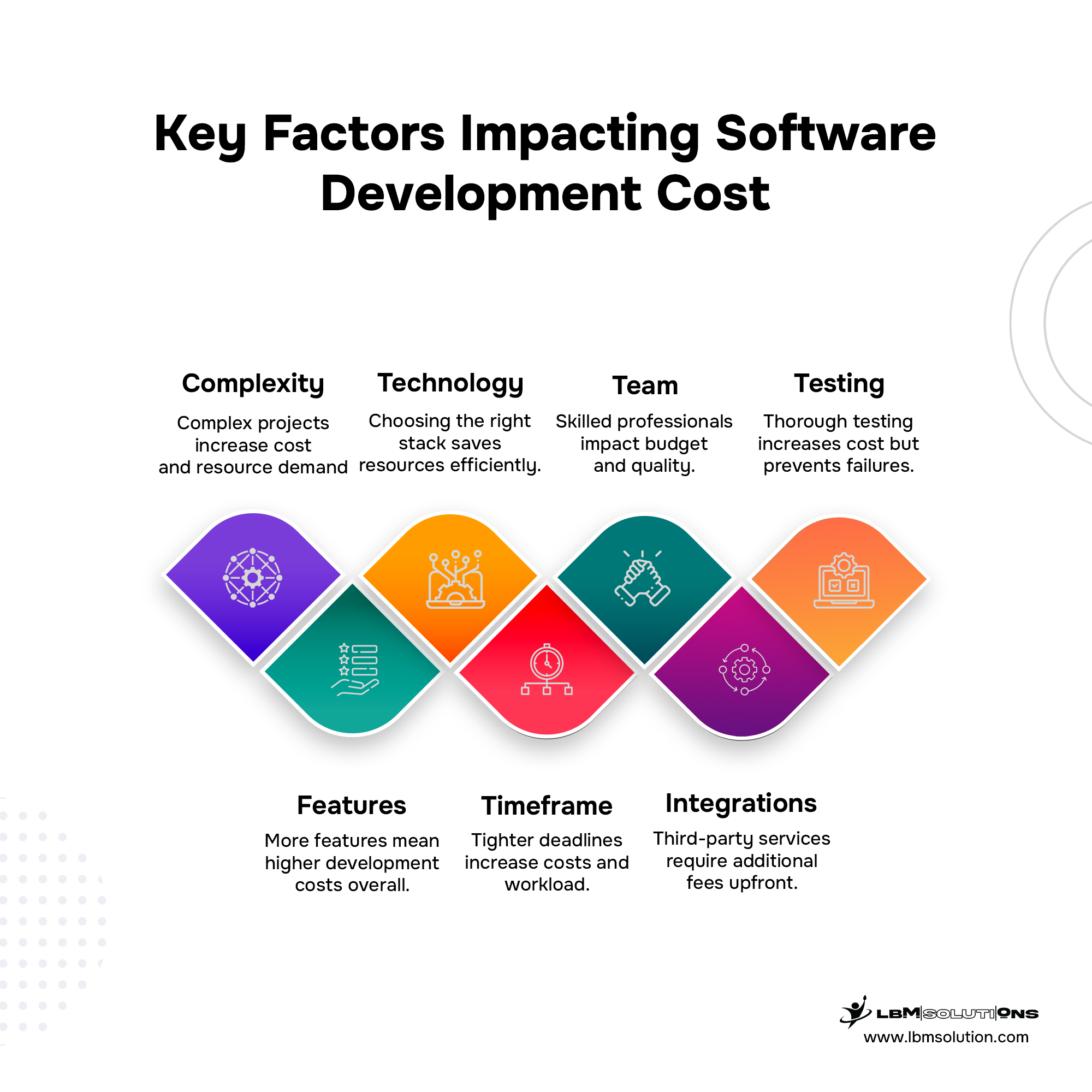
Project Complexity : Project complexity directly affects the overall cost. More complex projects demand more time, resources, and skilled professionals. Reducing complexity enables to decrease of unnecessary expenses.
Features & Functionality : More features mean more development time and resources. Businesses should prioritize essential rather than non-essential features to control their budget significantly.
Technology Stack : The next one is the technology stack choice, which influences development time and budget. The right technologies can save resources and ensure higher product performance.
Development Timeframe : Tight deadlines might increase costs due to extra resource usage, while extended ones can lower costs but cause delays. Thus, a structured software development process is required.
Team Expertise & Location : Hiring in-house or outsourcing teams can help reduce expenses. Highly skilled professionals can be expensive, but outsourcing can maintain quality and budget too.
Third-Party Integrations : Third-party integrations add extra costs to your project. Services like payment gateways or APIs require additional licensing fees and development time.
Testing & QA : Thorough testing ensures the product works as expected but comes with a cost. Rushing or skipping the testing phase can lead to costly mistakes and customer dissatisfaction.
Proven Techniques to Reduce Software Development Costs
Unnecessary expenses can drain your budget and slow down product development. Startups looking to cut costs while building software products can benefit from tried-and-tested methods. Some cost-effective techniques to develop your product are defined below.
Define Clear Requirements
When you validate your software idea at the beginning of the project, you set a solid foundation for development. A clear product plan shows the way forward, steering everyone on track. Actually, data from Standish Group reveals - firms adjusting needs through real user feedback often cut building expenses by nearly one third.
Without clarity, confusion sets in; developers build features that aren’t needed, and the budget seems out of control. However, a clear approach to defining requirements saves time and money and ensures a smooth and budget-friendly software development process. It involves
Define detailed documents to avoid miscommunication
Create visual representations to refine ideas
Involve stakeholders early to align project expectations
Ensure market demand for your product before development
Allow flexibility for improvements based on feedback
Use the MVP Approach
A fresh start often begins with just the core pieces. Trying out an idea can mean building only what matters at first. Think of it like making a cake without all the extras - just mixing flour, sugar, eggs. When that version works, then comes the chance to include frosting or sprinkles. Learning happens early when nothing unnecessary gets in the way.
Most big products begin small. A minimal version hits the market fast, skipping long waits. Feedback comes early from people actually using it. Changes follow what users really do, not guesses. Building less means spending less at first. Wasting time on unused parts drops sharply. Some now-famous companies began exactly this way - simple, then scaled.
Choose Cost-Effective Development
When it comes to software development, one question stands out in founders' minds: “How do you estimate software development costs accurately?” The answer lies in choosing gainful development strategies that balance price and performance.
It’s just like building a house. You won’t spend extra money on luxury materials if all you need is a solid structure to start with. Similarly, the same principle applies when developing software. There are many ways to save on the details without compromising the overall result.
Development Team : Choosing between hiring an in-house team or outsourcing is like deciding whether to build the house yourself or hire professionals. Hiring in-house gives you complete control over the project but comes with higher costs due to salaries, overheads, and office space. On the other hand, outsourcing is just like hiring a contractor, which can save money and maintain quality.
Open-Source Solutions : Open-source software can save considerable money. Their libraries, frameworks, and tools are free to use. For instance, popular frameworks like React or Angular can help you build the front end without spending on licensing fees. But just like choosing the right materials for your house, you must ensure these solutions align with your project’s needs.
Right Tech Stack : The right tech stack can optimize both development speed and cost. It’s like selecting the right set of tools to build your house. Tech stacks like JavaScript, React, and Node.js are popular as they are versatile, well-documented, and supported by a large community. These technologies reduce time and costs, and experienced developers can be found easily.
Adopt Agile Development
A precise software development methodology plays a key role in managing costs. Agile methodology ensures that resources are only spent on what really matters. Instead of completing the entire project in one go, you break it into smaller parts called sprints. After each sprint, you assess the progress, gather feedback, and make necessary adjustments.
With the Agile software development approach, startups can deliver a product that meets user expectations while avoiding expensive mistakes.
Automate Testing & Deployment
Fiddling with each step by hand in coding? Feels like a chore, doesn’t it. A fresh chunk of code shows up - somebody needs to verify it runs clean. Yet machines jump in here, scanning automatically whenever changes land. Mistakes get caught fast when tests fire without being asked.
A good example? GitLab, widely used in DevOps, handles testing and rollout without manual steps, so teams can release changes fast yet securely. Because it runs checks automatically whenever fresh code arrives, the system stays solid at all times. With these built-in workflows, progress moves quicker, mistakes drop off, expansion becomes smoother.
Optimize Resource Allocation
Managing resources is like being in charge of a team in a relay race. You have to pick the people for the job. You also need the tools and enough time to get things done. In software development this means giving the tasks to the right people at the right time. When you do this you do not waste time and resources. Resources are used in a way. This is good for startups because it helps reduce costs. Effective resource allocation is important, for software development. It helps startups use resources wisely and reduce costs.
Founders should assign the right resources based on skill sets and availability, and ensure that the team works at full capacity, improving overall efficiency. When resources are allocated wisely, you ensure that project expenses stay within budget, faster delivery times, and fewer errors to create a successful product.
Budgeting & Funding Options
In software development, managing your funds and setting realistic budgets ensures that you avoid overspending and your project remains aligned from concept to launch. Because creating a product launch strategy is much like preparing for a big trip. You must carefully plan how much to spend, where to allocate your resources, track product launch metrics, and ensure your budget stretches from start to finish.
A clear financial plan for your software development project allows startups to launch a successful product without the fear of running out of money. By securing proper funding and tracking progress against realistic budgets, they can build quality products while keeping costs in check.
Conclusion
Developing software on a budget is not about cutting corners. It is about making a plan and using the money you have in the best way. You need to think about what's really important for your software and make sure you have enough money for those things.
When you understand how much it costs to make software and you use ways to save money like working in small steps and using only what you need you can make your software company work well and grow. Making software can be hard. If you work with the right people who make software they can help you make your idea real. Developing software on a budget is, about developing software in a smart way. So, take charge of your project, make informed decisions, and watch your software development story unfold, without the financial stress.
Planning this work? Start with the crm buyer's guide.
As Chief Technology Officer at LBM Solutions, Manjit Parmar oversees technical strategy, infrastructure, and product development. His expertise in Blockchain and AI enables the creation of secure, data-driven, and scalable systems aligned with business growth and innovation.
Keep reading
SaaS vs AaaS: A Complete Breakdown of Both Models in 2026
Learn the difference between SaaS and AaaS, how AI agents work, and why businesses are shifting toward autonomous software systems.
The Real Guide to AI Real Estate App Development (2026)
Plan your AI real estate app in 2026, features, cost, tech stack & tips to find the right AI real estate app development company.
How Stablecoins Are Replacing Traditional Bank Accounts in 2026
Learn about How Stablecoins Are Replacing Traditional Bank Accounts in 2026. This comprehensive guide covers everything you need to know for beginners.
Build it with engineers.
Product engineering for fintech and SaaS, inside your stack and your repo.